Rules, Constitution and Rituals
“Come here, Brother Wolf. I command you on behalf of Christ that you do no harm to me or to anyone.”

The rules, constitutions and rites do no harm to anyone, although at times if can be challenging to following and appreciate their existence.
St Francis created rules for his Franciscan Orders (Friars, Poor Clares, Seculars) primarily to structure and guide their shared mission of living the Gospel literally, ensuring unity, defining roles for different vocations (clergy, cloistered, lay), and adapting his simple life to the Church’s needs as his following grew, preventing chaos and maintaining focus on Christ, obedience, poverty, and service.
Key Reasons for the Rules:
Gospel Living: The core purpose was to observe the “holy Gospel of our Lord Jesus Christ” as a practical guide for daily life, focusing on poverty, obedience, and chastity.
Growth & Structure: As more people joined, St. Francis needed to organize them into distinct groups (First, Second, Third Orders) with specific paths (friars, nuns, lay people) to prevent confusion and support different lifestyles.
Clarification & Guidance: The Rules provided simple, scripturally-based direction for new members, ensuring they understood their commitment and function within the growing Franciscan family.
Church Approval: Rules were necessary for recognition and confirmation by the Pope, like Pope Innocent III, to ensure the movement was orthodox and integrated into the Church.
What St. Francis essentially gave all of us was his exhortation, the prologue to our Rule. Rule developed over the years with the latest version from 1978 (see below). OFS is for seculars, not just lay people. Diocesan priests, popes who are not lay but secular (not living in religious order) can be OFS.
Adapting to Vocations:
- First Order (Friars Minor): For men living apostolically in the world.
- Second Order (Poor Clares): For women in cloistered contemplation, needing a separate rule.
- Third Order (Secular Franciscans – OFS): For lay people (married or single) who could not live in community but wanted to live the Gospel in their daily lives and families.
Preventing Extremism/Chaos: By defining the life, the Rules provided boundaries and focus, channeling the initial fervor into a sustainable, organized spiritual movement.
In essence, the Rules, Constitutions and Rites were tools to make the radical, Gospel-centered life of St Francis a lasting, structured reality for a diverse spiritual family within the Church.
Official Documents
All the following documents may be found on the Secular Franciscan Order International Website here.
THE RULE
The Rule of the Secular Franciscan Order (OFS Rule): This document, approved by Pope Paul VI in 1978 and updated in 2020, serves as the foundational guide for the Secular Franciscan life, focusing on observing the Gospel by following St. Francis’s example.
GENERAL CONSTITUTIONS
The General Constitutions of the OFS: These Constitutions apply the Rule and were approved by the Holy See. They provide detailed norms for the structure and daily life of the Order.
THE RITUAL
The Ritual of the Secular Franciscan Order: This document contains the official ceremonies, rites (such as the Rite of Admission and Profession), and prayers used within the OFS fraternity.
The Admonitions
These are 28 spiritual counsels written by St. Francis to guide inner virtue. They are different from the Rules. The Rules are the formal, papally-approved canonical framework that legally governs the Secular Franciscan Order (OFS).
While both guide Secular Franciscans, they serve fundamentally different functions in the life of the order.
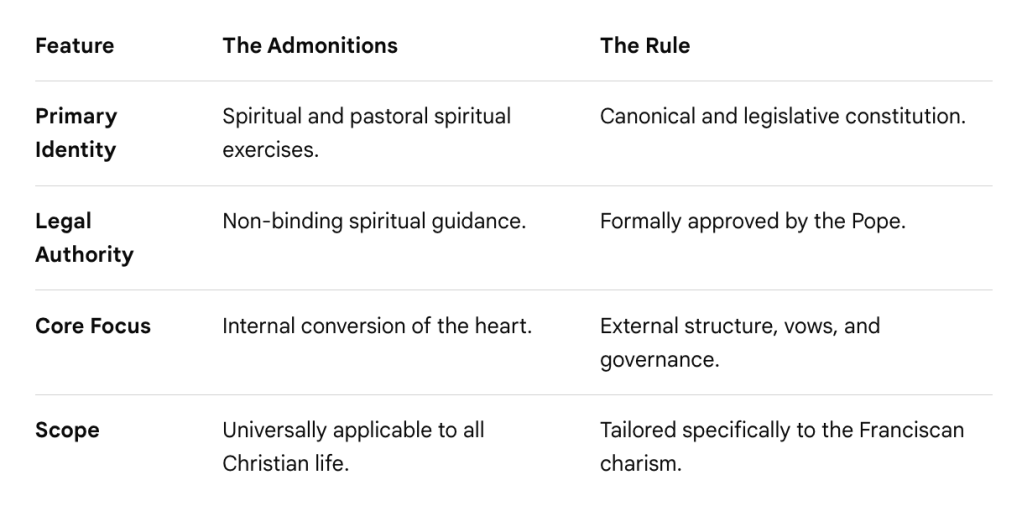
Read more about The Admonitions
The Statutes
The governing documents are called Statutes (rather than “statues”). The OFS does not have iconic physical statues, but it is strictly governed by a specific hierarchy of legal statutes and constitutional texts.
The Core OFS Statutes and Documents
The OFS is structured globally and locally through the following official legislative levels:
- International Statutes: These govern the worldwide fraternity and the International Council of the OFS (CIOFS). They are approved by the General Chapter of the OFS.
- National Statutes: Every country establishes its own specific bylaws to manage national operations. For example, the OFS-USA National Statutes detail the canonical structure, voting procedures, and local fraternity roles within the United States.
- Regional and Local Statutes: Individual regions and local fraternities create specific guidelines tailored to their geography, which must be approved by the council at the level above them.
- Statutes for Spiritual and Pastoral Assistance: These dictate the relationship, spiritual guidance, and pastoral care provided to the OFS by the First Franciscan Orders and the Third Order Regular (TOR).
Higher Governing Authorities
The specific statutes above must always align with the two highest authorities of the Order:
- The OFS Rule: The foundational rule of life originally given by St. Francis, with the modern version approved by Pope Paul VI in 1978. See the updated 2020 version above.
- The General Constitutions: The universal administrative laws that apply to every Secular Franciscan worldwide
The governing documents of the Secular Franciscan Order (OFS) form a hierarchical structure. They work together to translate the spiritual ideals of Saint Francis into practical, everyday living and organisational administration.
Here is the difference between the four documents:
1. The Rule
- What it is: The foundational document of the OFS, approved by Pope Paul VI in 1978. Updated in 2020.
- Purpose: It outlines the core “form of life” for Secular Franciscans. It is a spiritual document that defines the charism, obligations, and spirit of the order, calling members to live the Gospel in the world.
2. General Constitutions
- What it is: A comprehensive document that interprets and expands on the Rule.
- Purpose: It provides practical guidance on how to live the Rule in daily life. It details the structure, organisation, and operation of fraternities at all levels (local, regional, national, and international) and establishes standard norms for formation and governance.
3. National Statutes
- What it is: Specific, tailored rules developed by the National Fraternity of a specific country (e.g., the United States, Great Britain, Singapore).
- Purpose: They apply the General Constitutions to the local culture, language, and civil laws of that particular country. They cover things like local membership dues, national elections, and specific regional practices, always ensuring they do not contradict the Rule or General Constitutions.
4. International Statutes
- What it is: The governing regulations for the International Fraternity of the OFS.
- Purpose: They outline the specific procedures for the global governance of the order. This includes rules regarding the International Council of the Secular Franciscan Order (CIOFS), the election of the General Minister, and international assemblies.
In short, The Rule provides the spiritual vision, the General Constitutions provide the worldwide rules, and the National and International Statutes provide the practical, localised and global administrative details needed to operate the fraternity effectively
The Story of Brother Wolf
The famous wolf of Gubbio appeared to St Francis around 1220 while St Francis was staying in the Italian town of Gubbio, where a fearsome wolf was terrorizing people and livestock, leading St Francis to venture out and tame the beast into a peaceful, community-fed companion, a story detailed in The Little Flowers of St Francis.
When the wolf sees St Francis, he comes charging at the saint with his mouth open, ready to attack. St Francis immediately makes the sign of the cross over him and says, “Come here, Brother Wolf. I command you on behalf of Christ that you do no harm to me or to anyone.” As soon as St Francis did this, the fearsome wolf closed his mouth and stopped running; and once the command was given, it came meekly as a lamb, and threw itself at the feet of St Francis.
St Francis recognized the coldness in Brother Wolf and chose to offer warm embrace of acceptance. forgiveness, and non-judgment. He gave him an opportunity to begin again.
In many ways, we are similar to Brother Wolf. Like him, we may have some “coldness” in our heart. We may hide behind the fierce persona to hide our fear and insecurity, and we don’t let others come nearer to us because we are afraid or threatened.
The encounter of St Francis and Brother Wolf teaches us to always be merciful and compassionate, to always offer acceptance and loving embrace, so that we can live side-by-side with our fear and insecurities. What happened has happened, and we can live with our past. As long as we have God who always offers us acceptance, mercy, and love, we can live in the present and face the future with hope.
Reflection
- Is there any part of you that you are not proud of?
- Is there anything you are afraid of?
- Spend this time with the Lord, to learn to accept, befriend, and embrace these wolves in our heart.

